
Your boarding pass is in hand and your bags are packed, but your entry into Manila or Cebu might still be at risk if you're missing a single digital QR code. Many travelers reaching out to us ask, "do I need arrival card for Philippines?" before realizing the old yellow paper forms were officially retired in April 2026. It's completely normal to feel a sense of urgency about these digital requirements, especially when the official 72-hour registration window leaves very little room for technical errors or website glitches.
We understand that navigating government portals can be frustrating when the stakes involve being denied boarding at the gate. This guide gives you everything you need to know about the mandatory Philippines eTravel registration to ensure a smooth, error-free entry. You'll learn exactly how the 2026 rules function, how to secure a valid QR code in your inbox, and why professional oversight is the most reliable way to guarantee your data is typo-free before you reach the immigration desk.
Key Takeaways
- Understand why the digital eTravel QR code is now the only legal entry requirement for every traveler, including infants and children.
- Clarify the answer to "do I need arrival card for Philippines" by exploring the transition from traditional paperwork to the mandatory 2026 electronic system.
- Navigate the strict 72-hour registration window and learn how to manage time zone calculations to avoid invalid submissions.
- Identify the specific flight and passport data required to bypass common technical frustrations like site timeouts or email delivery delays.
- Discover how professional human oversight acts as a protective shield against the minor typos and data errors that often lead to boarding denials.
Current Philippines Entry Requirements: Do I Need an Arrival Card?
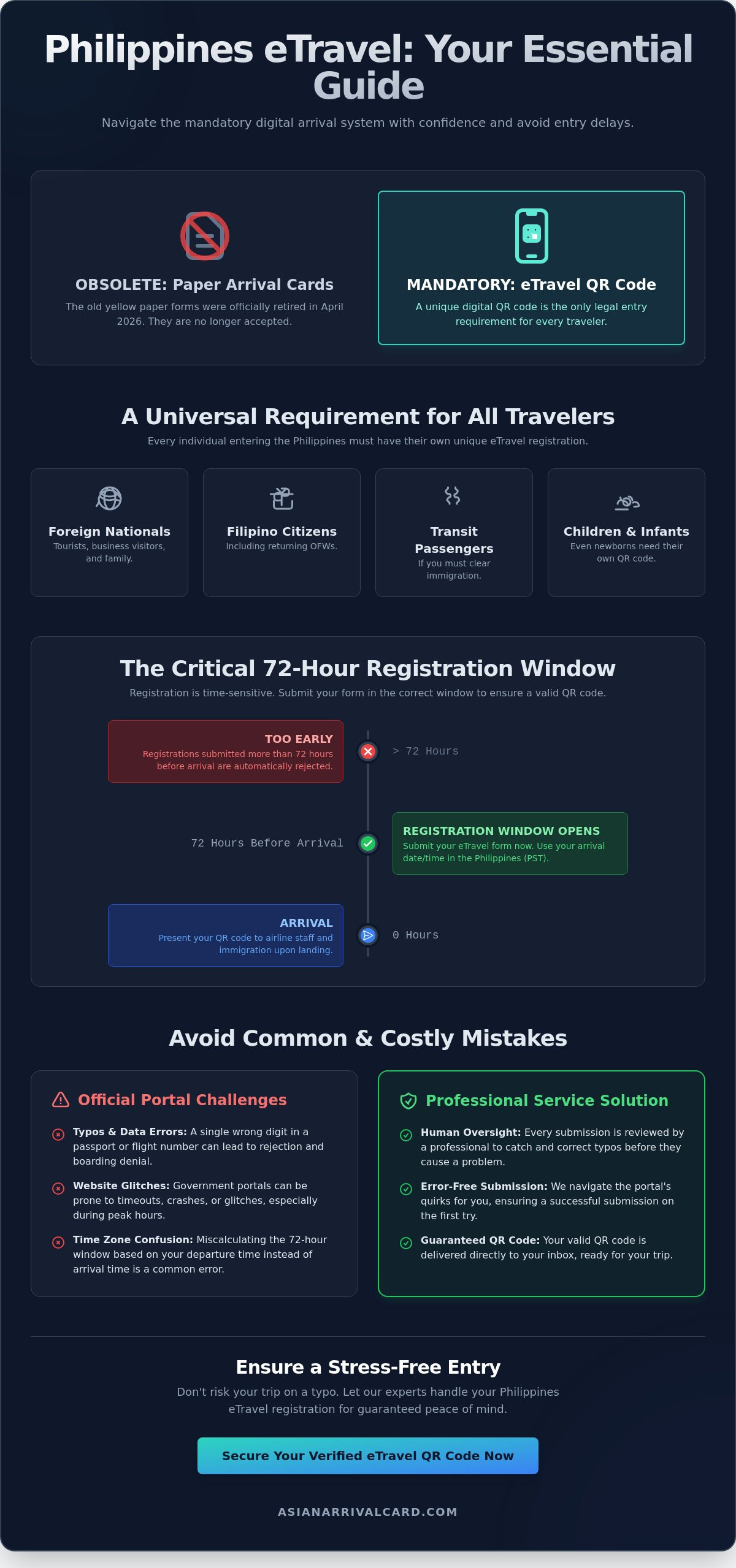
The landscape of international travel to Southeast Asia has shifted toward total digitalization. As of April 2026, the traditional paper arrival card has been fully replaced by the eTravel system. This isn't just a minor update; it's a complete overhaul of how the Bureau of Immigration processes visitors. When planning your trip, you might search "do I need arrival card for Philippines" only to find outdated advice. The reality is that while the physical card is gone, the requirement for a digital declaration is more strictly enforced than ever. This mandatory process integrates your immigration details, health declaration, and customs information into a single, secure QR code.
This shift aims to streamline the 6.4 million international arrivals recorded in 2025. However, while the goal is efficiency, the reality for many travelers is a new layer of digital anxiety. Missing this step doesn't just mean a delay at the airport; it often results in being denied boarding at your point of origin. Airline staff are now trained to verify your QR code before you even reach the security line. This system works in tandem with the broader Visa Policy of the Philippines, ensuring that every traveler is accounted for before they touch down in Manila or Cebu.
Who is Required to Register?
The digital mandate is universal. Every individual crossing the border must have their own registration, regardless of age or status. This includes:
- Foreign Nationals: All visitors entering for tourism, business, or family visits.
- Overseas Filipino Workers (OFWs): Returning citizens must register to ensure their health and employment data is current.
- Transit Passengers: If your layover requires you to clear immigration to switch terminals, you're considered an arrival and must present a code.
- Children and Infants: Even the youngest travelers require a unique QR code filed under their passport details.
Arrival vs. Departure Requirements
The eTravel system serves as a two-way gate. For everyone entering the country, arrival registration is a non-negotiable requirement that must be completed within 72 hours of landing. Foreign nationals generally don't need to register when leaving, but Filipino citizens are required to complete a departure declaration between 72 and 3 hours before their flight. Because the system is unforgiving of typos or missing data, having a meticulous partner to review your submission can be the difference between a smooth transition and a logistical nightmare at the gate. If you're asking "do I need arrival card for Philippines" at the last minute, you're already in the high-stakes window where errors are most common.
Understanding the eTravel System: Timelines and QR Codes
Successfully entering the Philippines requires more than just a passport; it requires precision timing. Many travelers still ask, "do I need arrival card for Philippines" only to find that the digital system is strictly time-bound. The eTravel registration isn't something you can check off your list weeks in advance. It's a live system that requires up-to-the-minute accuracy regarding your health and flight status. To secure your entry, you must follow a specific sequence of actions to generate your mandatory QR code.
The process follows five critical steps. First, you must determine your exact arrival time in Philippine Standard Time (PST), as this dictates your eligibility window. Second, access the Official eTravel Portal exactly 72 hours before that scheduled arrival. Third, you'll need to complete the personal profile and flight details sections meticulously. This is where most errors occur, as a single digit wrong in a passport number can trigger a system rejection. Fourth, answer the health declaration questions based on your current status. Finally, save or print the generated QR code for inspection at the gate. For those who want to avoid the stress of manual entry, Philippines eTravel assistance provides a professional review to ensure every detail is perfect before submission.
The 72-Hour Rule Explained
The 72-hour window is a hard limit set by the Bureau of Immigration. You cannot register earlier because the system is designed to capture a "snapshot" of your health and travel history immediately before you fly. It's vital to use your arrival date in the Philippines, not your departure date from your home country, when calculating this window. If your flight is pushed back due to a delay, your QR code generally remains valid as long as the arrival still falls within a reasonable timeframe of your original declaration. However, significant delays or flight number changes may require a fresh registration to maintain data integrity.
Green vs. Red QR Codes
The color of your QR code determines your experience at the immigration desk. A Green QR code is the goal; it signifies that your data is complete and you've met all health protocols, allowing you to use the "Fast Lane" for a quick entry. A Red QR code is generated if the system detects missing information or potential health risks based on your declaration. A Red QR code requires secondary health screening upon arrival. This doesn't mean you'll be deported, but it does mean you'll face additional interviews and manual document checks that can add hours to your journey. For travelers from Manitoba who want to ensure they are medically prepared for their trip and avoid health-related delays, it may be beneficial to visit AskMyDoc.ca for a virtual health consultation. Using a meticulous concierge service helps ensure you provide the right data to secure a Green status from the start.
Official Portal vs. Concierge Support: Navigating Common Pitfalls
While the official eTravel portal is free, it operates with the cold indifference of an automated system. For the 5.95 million tourists who visited the country in 2024, many discovered that a single keystroke error can derail an entire vacation. You might ask, "do I need arrival card for Philippines" and assume the digital version is as simple as the old paper slips. It isn't. The digital system requires absolute data matches. If you misspell your middle name or swap two digits in your passport number, the system will still issue a code, but it won't match your legal documents. Immigration officers at the border don't have the authority to fix your digital record on the fly; they simply see a mismatch and a potential security risk.
Technical hurdles are another common barrier that travelers face. Users often report site timeouts during peak hours or frustration when image uploads for passport scans fail repeatedly. Even if you successfully navigate the form, email delivery delays can leave you standing at the check-in counter without the necessary QR code in hand. This is where the value of a concierge service becomes clear. We act as your meticulous private assistant, standing between you and these automated pitfalls to ensure your entry is guaranteed.
The Risk of Automated Errors
An automated government portal cannot tell if your flight number belongs to a different airline or if your passport expiry date is logically impossible. It simply accepts whatever data you type. If you realize you've made a mistake while standing in the check-in queue, the stress is immense. As noted in the Australian Government travel advice, ensuring your documentation is exactly right before you head to the airport is essential for a trouble-free entry. Our human agents perform a manual side-by-side review of your passport scan against your typed data, catching the tiny typos that machines ignore.
Customer Support Comparison
Official support channels are typically limited to email tickets with response times that don't align with the urgency of a departing flight. If you're flying tomorrow and haven't received your code, an automated message promising a response in several business days is useless. In contrast, concierge benefits include real-time support and rapid processing. You're trading a small service fee for the peace of mind that a professional has verified your submission. This premium relief allows you to focus on your trip rather than worrying about digital red tape.
Preparation Checklist: Data Needed for a Successful Submission
Before you sit down to register, gathering your documentation is the most effective way to prevent mid-application timeouts or technical glitches. You are likely wondering, "do I need arrival card for Philippines" while balancing a dozen other travel tasks. To make this as seamless as possible, you must have four specific items ready. First, your passport must have at least six months of remaining validity from your arrival date. Second, keep your confirmed flight itinerary open to verify your flight number and airline name. Third, you need the full physical address of your stay, whether it's a hotel in Makati or a family home in Davao. Finally, ensure you have access to an active email address where your QR code will be delivered.
Having these details at your fingertips reduces the time spent on the portal, which is prone to resetting if left idle for too long. Accuracy is paramount here. A single digit error in your passport number or a misspelling of your hotel name can cause issues during the verification process. By preparing ahead of time, you transition from a state of travel anxiety to one of organized readiness.
Registering Families and Groups
Traveling in a group requires additional coordination to avoid terminal bottlenecks. The eTravel system includes an "Add Passenger" feature, allowing one head of the family to register multiple members under a single account. This is particularly helpful for minors who cannot complete the form themselves. If children are traveling without parents, specific documentation regarding guardianship must be ready for the digital upload. Having all QR codes organized on one device, or printed in a single folder, ensures your group moves through immigration as a single, efficient unit.
Health and Customs Declarations
The eTravel system is a unified border control tool that combines several previously separate forms into one digital experience. In 2026, health protocols remain a core component of the declaration, asking for recent travel history and current symptoms to protect public health. You must also declare currency exceeding $10,000 USD or its equivalent, along with specific limits on tobacco and alcohol. For example, the duty-free allowance typically covers two liters of alcohol and up to 400 cigarettes. Failing to declare these items digitally can lead to fines or confiscation upon landing. If the thought of managing multiple family members and complex customs rules feels overwhelming, you can secure professional Philippines eTravel assistance to ensure your submission is flawless and your entry is guaranteed. This meticulous oversight ensures you never have to ask "do I need arrival card for Philippines" while standing in a crowded airport line.
Fast & Secure Philippines eTravel with AsianArrivalCard
The transition to a digital entry system shouldn't be the most stressful part of your journey. While you might still be asking, "do I need arrival card for Philippines," the real question is how you can secure your entry without the risk of technical failure. AsianArrivalCard provides a premium concierge experience designed specifically for time-conscious travelers who value accuracy over a DIY approach. We act as your stabilizing force, standing between you and the cold, unforgiving nature of automated government portals. By choosing our assistance, you're not just filing a form; you're hiring a meticulous private assistant to manage your travel logistics.
Every application submitted through our platform undergoes a rigorous review by a real human agent. This human-first approach is our remedy for the "Typo Trap" that often leads to boarding denials at the airport. We don't rely on algorithms to check your data. Instead, our specialists verify your passport details against your typed information to ensure zero errors. This meticulousness is why we can offer a fast-track processing experience that delivers your confirmed arrival card via email within 4 hours of your submission. We also provide a money-back guarantee; if your application is rejected due to a system error, you don't pay a cent for our service.
The Concierge Advantage
More than 40,000 travelers have already chosen our professional assistance over the official portals. They recognize that the "free" government site doesn't come with a support team when things go wrong. We provide 24/7 WhatsApp support to handle last-minute travel changes, flight delays, or urgent questions that arise while you're in transit. Your data security is our highest priority, which is why we employ high-level encryption protocols to protect your personal information throughout the process. This level of personal attention transforms a bureaucratic hurdle into a moment of premium relief.
How to Start Your Application Today
Securing your entry document is a straightforward, three-step process that takes less than two minutes of your time. First, fill out our simplified form on AsianArrivalCard.com with your basic flight and stay details. Second, upload a clear scan of your passport. Our agents will then do the heavy lifting, navigating the official system on your behalf and verifying every data point for absolute accuracy. Finally, check your inbox for your valid QR code. You can Apply for your Philippines eTravel Card now and fly with the confidence that your paperwork is in expert hands. Don't leave your holiday to chance when professional oversight is just a few clicks away.
Secure Your Entry and Travel with Confidence
The transition to a digital border doesn't have to be a source of travel anxiety. As we've explored, the answer to "do I need arrival card for Philippines" is a definitive yes, but it must be the 2026 eTravel QR code rather than the retired paper slips. Navigating the strict 72-hour registration window and avoiding the technical glitches of automated portals are the final hurdles between you and your destination. By preparing your documentation in advance and understanding the logic behind the eTravel system, you ensure a much faster experience at the immigration desk.
If you prefer to hand over these logistical burdens to a capable expert, we're here to act as your protective intermediary. Our team provides a Human Review Guarantee to catch the tiny typos that automated systems often ignore. With WhatsApp Support Included for any last-minute flight changes and a 4-Hour Expedited Delivery window, your peace of mind is our primary focus. We ensure your data is verified and your QR code is ready before you even reach the airport.
Get Your Philippines eTravel QR Code in 4 Hours
We look forward to helping you start your journey on the right note. Safe travels!
Frequently Asked Questions
Is the Philippines eTravel card free?
Registration on the official government portal is free of charge. However, many travelers choose to use a professional concierge service to manage the process on their behalf. This paid assistance ensures that a human expert reviews your data for typos and technical errors, providing a level of security and personal support that the automated official system doesn't offer.
How many hours before my flight should I register for eTravel?
You must register within 72 hours of your scheduled arrival in the Philippines. It's vital to calculate this window using Philippine Standard Time to ensure your submission is valid. If you find yourself at the airport asking, "do I need arrival card for Philippines," you are already in the critical window and should complete your registration immediately to avoid being denied boarding.
Do I need to print the eTravel QR code or can I show it on my phone?
You can present the QR code on your smartphone or tablet during immigration inspection. While a physical printout isn't mandatory, it's a wise precaution to save a screenshot or PDF version to your device. This ensures you can display the code even if you experience connectivity issues or battery failure after your long-haul flight to Manila or Cebu.
What happens if I made a mistake on my Philippines arrival card?
A mistake in your digital record, such as an incorrect passport number or a misspelled name, can lead to your QR code being rejected at the border. If you notice an error after your code has been generated, you'll typically need to start a new registration to correct the data. Our concierge service eliminates this risk by performing a meticulous human review of every application before it's submitted.
Do children and infants need their own eTravel registration?
Yes, every traveler must have an individual eTravel registration regardless of their age. Parents can register their children by using the "Add Passenger" feature within the system. Each infant will receive a unique QR code that must be presented alongside their passport. Failing to register a minor can cause significant delays for the entire family during the boarding process or upon arrival.
What should I do if I haven’t received my QR code via email?
Check your spam or junk folder first, as automated government emails are frequently flagged by filters. If the code is still missing, it's possible that a typo was made in your email address during the application. Travelers who use our premium assistance have access to direct WhatsApp support, allowing our team to quickly track your submission and ensure your code is delivered within our 4-hour processing window.
Can I register for eTravel after I land in the Philippines?
While airport staff can technically assist unregistered passengers upon landing, most airlines will not allow you to board your flight without a valid QR code. Completing the registration after you land often leads to long wait times in secondary screening areas. It's much more efficient to handle the registration during the 72-hour window before your flight to ensure you can use the immigration fast lanes.
Is the eTravel system the same as a visa for the Philippines?
No, the eTravel system is a mandatory digital declaration for border control and health surveillance; it's not a visa. Even if your nationality allows for visa-free entry, you're still legally required to complete this registration. This system helps the Bureau of Immigration manage the 6.4 million arrivals recorded in 2025 by consolidating health, customs, and arrival data into one digital record that works alongside your passport.


