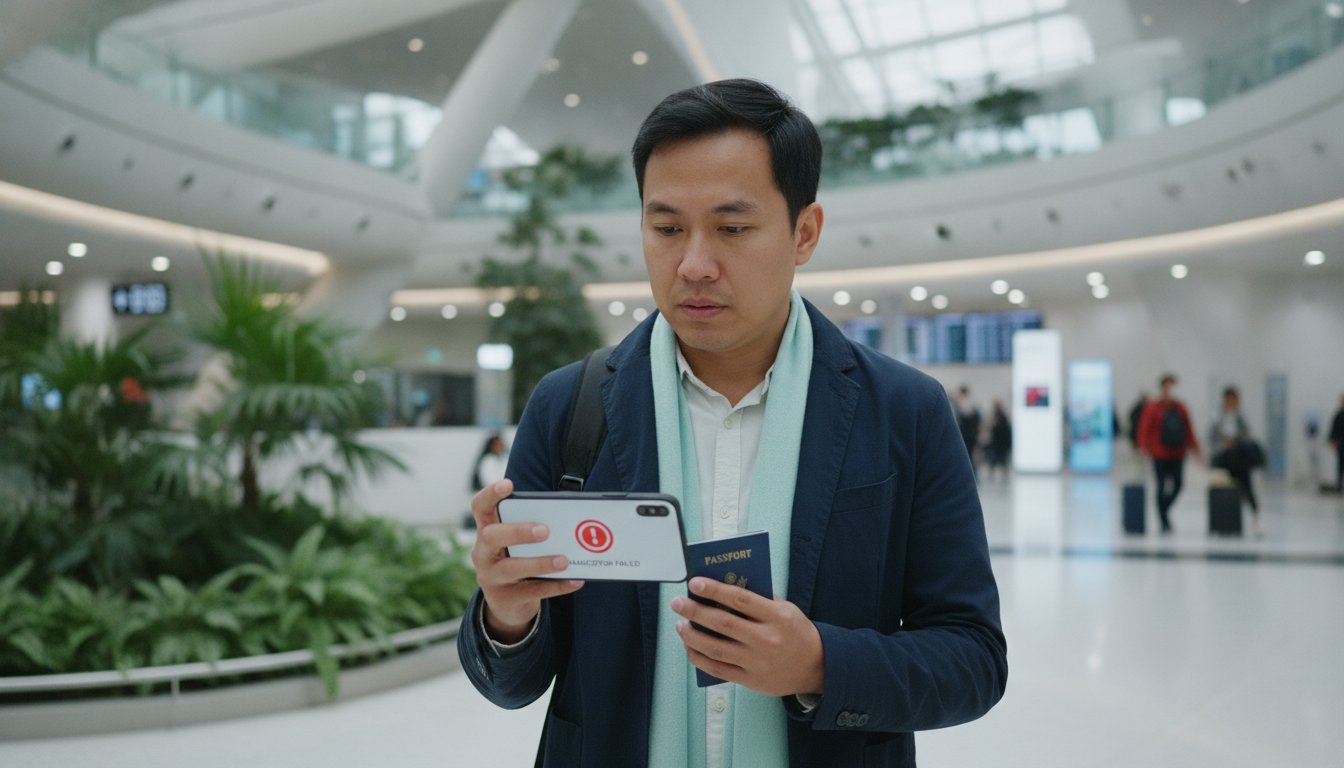
You're standing at the check-in counter with your bags packed and your passport ready, only to be told that your digital arrival card has been denied. The airline agent points to a cryptic error code on their screen, the queue behind you is growing, and your flight departs in less than two hours. It's a moment of cold, sharp panic that no traveler should have to face. You've likely spent hours preparing, yet a binary "No" from an automated government system now stands between you and your destination.
We understand how frustrating it is to feel trapped by a faceless algorithm that offers no feedback. If you're currently facing an arrival card rejected what to do is likely the only question on your mind. This guide provides the expert clarity you need to decode those confusing error messages and fix the underlying issues immediately. We'll walk you through a precise recovery plan to correct formatting mistakes and secure a confirmed digital arrival card in your inbox. By the time you finish reading, you'll have the professional insight required to clear immigration and get back to focusing on your journey.
Key Takeaways
- Identify the subtle data-formatting errors, such as OCR mismatches and biometric lighting issues, that cause automated systems to flag your application.
- Discover exactly why your arrival card rejected what to do next to resolve cryptic error codes before your boarding time.
- Understand the specific 2026 regional requirements for Thailand and Singapore that often lead to unexpected denials for unprepared travelers.
- Master the techniques for high-resolution document scanning and flight verification to ensure your next submission passes the digital gate on the first attempt.
- Explore how human oversight and expert verification provide a protective layer against the rigid, unforgiving nature of automated government portals.
Why Was My Arrival Card Rejected? Common 2026 Error Triggers
Digital systems are efficient, but they're also unforgiving. Most travelers assume a human reviews their application, but in 2026, the first line of defense is an automated script. To understand what is an arrival card in the modern era, you must view it as a high-stakes data entry task rather than a simple form. When you receive a denial, it's rarely because of your travel history. It's almost always because your data was formatted in a way the machine couldn't interpret. If you're staring at a screen wondering why your arrival card rejected what to do next, the answer usually lies in technical precision.
One of the most frequent triggers is an Optical Character Recognition (OCR) error. These systems often misread characters that look similar to the human eye but appear identical to a machine. Common errors include:
- Mistaking the number '0' (zero) for the capital letter 'O'.
- Confusing the number '1' (one) with a capital 'I' or lowercase 'l'.
- Misinterpreting a blurry '5' as an 'S'.
If your passport number contains these characters, even a slight blur in your upload can cause a mismatch. Similarly, biometric standards have tightened significantly. In 2026, even a faint shadow across your cheek or a low-resolution scan can trigger an automatic failure. The system isn't "guessing" what you look like. It's looking for specific pixel patterns that must meet strict government thresholds for facial recognition.
Date format confusion remains a massive hurdle for international visitors. Many travelers instinctively use their home country's format, such as MM/DD/YYYY. However, most Southeast Asian portals require DD/MM/YYYY. Entering your birth month and day in the wrong order results in an instant, automated denial because the system cannot verify the date against your passport's encoded data. Finally, inconsistent flight data causes issues. If your arrival card lists a flight number that hasn't updated in the airline's manifest, the system flags the entry as potentially fraudulent. Accuracy is essential.
The 'Binary Gate' Problem: Why Robots Reject You
Government portals utilize automated screening scripts to process thousands of applications every hour. These scripts lack the ability to interpret intent or correct minor slips. For instance, a single extra space at the end of your name can desynchronize the record. An OCR mismatch is a primary cause of travel document failure where automated character recognition software misinterprets a printed character on a passport as a different, similar looking symbol. Without human intervention, the gate simply stays closed.
Passport Validity and Hidden Expirations
Your passport might be physically "valid", but it may not meet entry criteria. Most 2026 regulations in Asia strictly enforce the 6-month validity rule. If you have five months left, the system will reject you immediately. Additionally, digital systems now check for damaged RFID chips. If the hardware is failing, the system cannot verify the document. If you're facing an arrival card rejected what to do first is check your document's physical and digital integrity.
Immediate Steps: What to Do After a Rejection Notice
Receiving a rejection notice is startling. It's usually a short, cold email that arrives just as you're finishing your packing. Your first instinct might be to submit a new application immediately. Don't do that. When your arrival card rejected what to do first is pause and analyze the feedback. Government portals often provide a specific "Reason" field or a numeric error code. While these are frequently vague, they're the only clues you have to prevent a second failure. There are various legal grounds for denying entry, but for most travelers, the issue is a simple technical mismatch that can be resolved with a methodical approach.
Check if the status is truly "Rejected" or simply "Pending." Some systems, especially during peak travel seasons in 2026, experience significant processing lag. If it's truly rejected, your next move is a technical reset. Clear your browser's cache and cookies. Better yet, switch to a different device entirely. Government servers often track "browser fingerprints" or IP addresses. If you keep submitting from the same environment without fixing the error, the system might auto-reject you based on previous failed attempts. Verify every character of your passport scan against the data you manually typed. It's easy to overlook a typo in a 10-digit passport number when you're stressed. Open the image file on a large screen and compare it side-by-side with your application form. If you find even one discrepancy, you've found your culprit.
Decoding Government Error Messages
Phrases like "Data Inconsistency" or "Unable to Verify" are common. They usually mean the automated system couldn't match your typed data with the uploaded passport image. Some portals have a "hidden" feedback section. Log back into the application status page rather than relying solely on the email notice. Look for a small "i" icon or a "View Details" link that might offer more granular info. Be careful with repeated attempts. We recommend a "3-strike rule." If you fail three times, stop. Multiple rejections in a short window can flag your passport as a security risk. If the reason remains unclear, it's often safer to seek expert document verification before trying again.
The 'Clean Slate' Technical Reset
Using an Incognito or Private window is essential for your second attempt. This ensures no old data fragments or autofill errors interfere with the new session. Also, review your document uploads. Strict 2026 file size limits often force travelers to compress their PDF or JPEG files. If you compress them too much, the text becomes unreadable to the system's character recognition software. Aim for a balance where the file is under the limit, usually 1MB or 2MB, but remains crystal clear when you zoom in on the passport number and name fields.
Regional Nuances: Thailand, Singapore, and Malaysia Rejections
Every digital border system has its own logic and specific triggers for denial. While the underlying technology is similar, the data points that immigration officials prioritize vary significantly across Southeast Asia. If you find your arrival card rejected what to do next depends heavily on which border you're trying to cross. In Thailand, the transition to the thailand digital arrival card tdac has replaced the old paper TM6 form, but it introduced a new hurdle: accommodation precision. In 2026, the Thai system frequently rejects applications if the 'Accommodation Type' doesn't perfectly match the registered business name of your hotel. Selecting 'Private Residence' for a registered Airbnb, for example, is a common reason for an immediate automated flag.
Singapore operates with even higher stakes. The SGAC is free, yet the penalties for providing false information are severe, including fines up to S$10,000. The primary trap in the Singapore system is the 'Health Declaration' section. If you inadvertently flag a symptom or fail to list a recent travel region that matches your flight history, the system won't just reject the card; it may trigger a manual interview upon arrival. Meanwhile, Malaysia's MDAC requires a strict 72-hour pre-arrival window. Submitting too early or too late often results in a session timeout or a rejection notice that cites 'Invalid Arrival Date'. Precision is your only protection against these rigid digital gates.
Managing Multiple Asian Entry Forms
Island hopping across Southeast Asia requires a high level of logistical synchronization. When you're moving between countries, you must ensure your arrival dates and flight numbers align across every form. This complexity is why Singapore arrival card help remains the most searched query for regional travelers. A mistake on your Thailand exit data can create a mismatch on your Singapore entry record, leading to cascading rejections. We recommend keeping a master digital folder of your flight manifests and hotel bookings to verify every entry in real-time.
Philippines eTravel Specifics
The Philippines system is particularly sensitive to browser versions. If your mobile browser isn't updated to the latest 2026 security standards, the QR code generation often fails at the final step. Utilizing philippines etravel assistance can help you navigate the 'Permanent Address' field, which is a frequent stumbling block for digital nomads who lack a fixed residence. Understanding the QR code results is also vital:
- Green QR Code: You're cleared for the express lane and automated gates.
- Red QR Code: You've been flagged for manual inspection or secondary health screening.
If you receive a Red code, don't panic. It often just means your documentation requires a human eye to verify a minor data inconsistency that the robot couldn't resolve.

How to Ensure Your Next Application is Approved
Securing an approval after an initial denial requires a shift from speed to meticulous precision. If you have already experienced an arrival card rejected what to do next is treat your second attempt as a formal document submission rather than a quick digital chore. Most rejections in 2026 stem from minor technical oversights that are easily preventable once you understand the strict logic of government algorithms. By following a structured approach, you can bypass the "Binary Gate" and ensure your data aligns perfectly with official records.
The quality of your documentation is the single most important factor. While modern smartphones have incredible cameras, they often struggle with the reflective laminate on passport pages. Glare or perspective distortion can render the Machine Readable Zone (MRZ) unreadable to an automated system. Whenever possible, use a flatbed scanner to create a high-resolution PDF or JPEG. This ensures the text is sharp and the alignment is perfect. Additionally, verify your flight number against the official airline manifest before typing it into the form. In 2026, many regional systems cross-reference your flight data in real-time; if you enter a codeshare number that doesn't match the primary manifest, the system may flag the entry as inconsistent.
Timing and technology also play subtle roles in your success. Avoid using your browser's "Auto-fill" feature. These tools often misinterpret form fields, placing your middle name in the surname box or your birth year in the passport expiration field. Manually typing every entry is the only way to guarantee accuracy. Furthermore, try to submit your application during the business hours of your destination country. If a system encounter a minor error that triggers a manual review, having local staff available to perform an override can significantly reduce your wait time compared to submitting at midnight local time.
The Gold Standard for Passport Photos
In 2026, biometric standards are more rigid than ever. You must remove your glasses, maintain a strictly neutral expression, and ensure your hair does not obscure your eyes or ears. Shadows on the background or uneven lighting on your face are the primary causes of biometric photo failure. Most Asian portals in 2026 require a minimum of 600x600 pixels for facial images and 1200x800 pixels for passport page scans to ensure character recognition software functions correctly. If your file is blurry when you zoom in, the robot will likely reject it.
Data Integrity Checklists
Your "Given Name" and "Surname" must match the MRZ at the bottom of your passport page exactly, including any special characters or spacing. When entering your accommodation, use the official hotel name as it appears on their business license rather than just a street address. For travelers with multiple stops or complex routes, seeking arrival card registration assistance is a strategic way to ensure all dates and flight legs are synchronized across different government systems. If you want to eliminate the risk of another denial, you can secure your arrival card with expert review to ensure every detail is flight-ready.
The Concierge Solution: Why Human Review Beats Automation
Automated government gates are efficient until they aren't. When a machine encounters a data point it doesn't recognize, its only response is a hard rejection. This binary logic is why so many travelers find themselves stuck at the check-in counter. If you've had an arrival card rejected what to do next usually involves finding a human who can bridge the gap between your physical documents and the machine's rigid requirements. A "human-in-the-loop" approach provides a protective layer that automated systems simply cannot replicate. While an algorithm sees a slightly blurry passport scan as a "No," an expert reviewer identifies the specific character mismatch and corrects it before the government ever sees the application.
Our service operates as a meticulous private assistant for your travel logistics. We don't just pass your data through; we verify it. This human oversight catches the subtle typos that robots ignore but border agents eventually flag, such as inverted surnames or mismatched flight codes. For those already en route to the airport, our 4-hour expedited processing offers a sense of calm urgency. It's a stabilizing force in a high-stakes situation. Real-time WhatsApp support ensures you aren't shouting into a digital void when a technical glitch occurs. You're talking to a professional who understands the pressure of a departing flight.
How the AsianArrivalCard Review Process Works
Our methodology is rooted in precision and transparency. Every passport scan and flight detail you provide undergoes manual verification by a trained specialist. This isn't just about data entry; it's about document integrity. You can learn more about the arrival card human review service to see how we contrast with standard automated portals. Once our team confirms your information is flight-ready, we handle the submission to the relevant government portal on your behalf. This intermediary role ensures that the data the government receives is formatted perfectly, significantly reducing the risk of a second denial.
Expedited Delivery and Support
We value your time and peace of mind above all else. Understanding the arrival card email delivery assistance timeline is crucial for planning your departure. Most expedited applications are processed and delivered within a 4-hour window, providing premium relief during stressful travel days. In the rare event that a system error leads to another rejection, we offer a straightforward money-back guarantee. We take full accountability for the accuracy of our review process. You shouldn't have to navigate the cold, unforgiving nature of automated systems alone. Avoid the stress of rejection; let our experts handle your Asian Arrival Card today.
Secure Your Entry with Confidence
Digital borders are built on rigid, automated logic, but your travel plans shouldn't be held hostage by a minor formatting error. You've seen how rejections often stem from simple OCR mismatches or regional data nuances that government portals fail to explain. If you're currently facing an arrival card rejected what to do is move beyond the frustrating cycle of trial-and-error. By prioritizing high-resolution documentation and precise data alignment, you can reclaim control over your itinerary and eliminate the fear of missing your flight.
We provide the essential human oversight needed to navigate these complex digital gates with ease. Our service offers a 4-hour delivery guarantee and meticulous review by real human agents who catch errors before they lead to a denial. With real-time WhatsApp support available for every traveler, you'll have a dedicated partner standing between you and potential entry issues. Don't let a faceless algorithm dictate your journey or waste your application fees. Secure your error-free Arrival Card now with expert human review and focus on the experiences waiting for you. Safe travels are just one verified step away.
Frequently Asked Questions
Can I fly if my arrival card was rejected?
No, you generally cannot board your flight if your arrival card has been denied. Airlines are required to verify your digital entry documents during the check-in process for countries like Thailand and Singapore. If you find your arrival card rejected what to do is resolve the issue immediately at the airport or before leaving for the terminal to avoid being denied boarding at the gate.
How many times can I re-apply for an arrival card after a denial?
There is technically no hard limit on the number of submissions, but we strongly recommend a three-strike rule. Submitting multiple failed applications in a short window can flag your passport number as a security risk in government databases. If your second attempt fails, it's safer to seek professional verification to identify the specific data mismatch before trying a third time.
Will I get a refund for the government fee if my card is rejected?
Most official government arrival cards, such as the SGAC, TDAC, or MDAC, are free of charge, so there is no official fee to refund. If you paid a fee on a third-party website, those charges are typically for processing and assistance services. These fees are rarely refundable once the service has been performed, so always verify the nature of the website before submitting payment.
How long does it take to get a new arrival card after fixing an error?
Most digital systems issue a response within minutes to a few hours after a new submission. In 2026, the Thailand and Malaysia systems often provide an instant QR code if the data matches the airline manifest perfectly. If your application requires manual oversight due to a previous rejection, expect a potential delay of up to 24 hours depending on the destination's local business hours.
Can I fix a typo on an already approved arrival card?
It depends on the specific country's regulations. Thailand's TDAC portal allows updates for flight and accommodation details, but core personal data like your passport number cannot be edited. For Singapore and Malaysia, you cannot fix typos on an approved card; you must submit an entirely new application, which then supersedes the previous record in the immigration system.
What is the most common reason for Singapore Arrival Card rejection?
The most common reason for a Singapore Arrival Card rejection is an inconsistency in the Health Declaration or flight details. If your answers regarding recent travel history don't align with the airline manifest or your passport's digital record, the system triggers an automatic denial. Precision in the health section is vital for passing Singapore's strict automated screening process.
Do I need a printed copy if my digital arrival card is approved?
You don't strictly need a printed copy as long as you can show the digital QR code or confirmation email on your mobile device. However, we strongly recommend carrying a physical printout as a backup. Technical glitches, dead phone batteries, or poor airport Wi-Fi can prevent you from accessing your digital record at the immigration counter, which may lead to significant delays.
What should I do if the government portal website is down?
If the official portal is inaccessible, your first step should be to clear your browser cache or try a different network connection. While these outages are rare in 2026, they do occur during peak travel seasons. If you're facing an arrival card rejected what to do is wait for the system to stabilize or use a professional service with redundant submission channels to ensure your data is processed.


